
The Defense Acquisition Newsletter
GSA

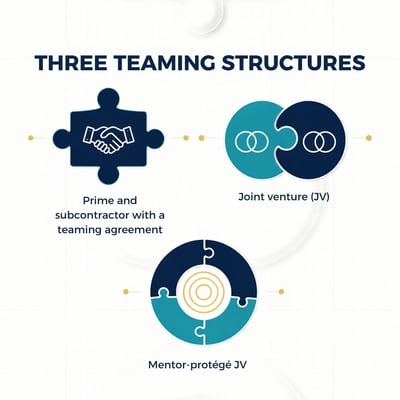
“Teaming” covers several very different legal arrangements, and small businesses often treat them as interchangeable. The structure you pick decides who signs the contract, who carries the risk, whether you stay eligible for the set-aside you’re chasing, and whether the promise you were given is worth anything if the relationship sours. A recent guide from CyberCloudAI.tech breaks down the three common options and the two rules that catch small primes off guard.
The Three Structures
- Prime and subcontractor with a teaming agreement: The most common arrangement. The prime bids, and the intended subs sign a teaming agreement before the bid and receive subcontracts after award.
- Joint venture (JV): Two or more companies form an entity that bids on and holds the contract, sharing work and profit under the JV agreement.
- Mentor-protégé JV: A JV between a small protégé and an SBA-approved mentor, which can be a large business. It is the one structure that lets a large company sit inside a small business set-aside bid, within limits.
Your Teaming Agreement May Not Be a Contract
The article points to Virginia cases (Cyberlock Consulting v. Information Experts and Navar, Inc. v. Federal Business Council) holding that an agreement to negotiate a subcontract in good faith after award can be an unenforceable “agreement to agree.” In Cyberlock, the same court enforced a different agreement because it attached the actual subcontract. Subs should negotiate essential terms first, attach the proposed subcontract, state a specific workshare, and avoid clauses that let the prime walk away if later talks fail.
The 50% Rule and the “Similarly Situated” Advantage
Under 13 CFR 125.6 and FAR 52.219-14, a small prime on a services set-aside generally can’t pay more than 50% of what it receives to subcontractors that aren’t similarly situated. Money paid to a similarly situated subcontractor, meaning one with the same small business status that is also small under the subcontract’s NAICS code, doesn’t count against you, as long as it performs the work with its own employees. Compliance is generally measured over the base term and each option period. The penalty is the greater of $500,000 or the amount paid above the limit.
The Ostensible Subcontractor Rule
Under 13 CFR 121.103(h), SBA can treat a prime and a non-similarly situated sub as affiliates if the sub performs the “primary and vital” work or the prime is unusually reliant on it. Red flags include a large sub that wrote most of the proposal, supplies key personnel, or owns the past performance. Meeting the 50% rule properly, with your own people doing the core work, is your best protection.
Strategic Action Plan for your Business
- Choose structure by opportunity, not habit. A prime-sub arrangement is usually simplest. Consider a JV only when both companies are truly needed at the core.
- If you’re the sub, attach the terms. Get the subcontract and a specific workshare in place before the proposal goes in, when you have leverage.
- If you’re the prime, track the 50% from the first invoice. Don’t wait for the end of an option period.
- Use similarly situated subs strategically. Confirm they self-perform, since whatever they pass down counts against you.
- Audit for ostensible subcontractor flags before you submit.
- Check your team’s cyber readiness. Make sure every member can handle the data the contract covers before you sign.
- Get legal review. A few hours with a government contracts attorney is worthy insurance.
Credits & Further Reading: This update is based on CyberCloudAI.tech’s guide to team structures. This is general information, not legal advice.